





Higgs Death Stranding: Full Character Analysis, Lore, and Impact Explained
Higgs Death Stranding: The Complete Character, Lore, and Narrative Analysis
The figure of Higgs in Death Stranding remains one of the most enigmatic, provocative, and symbolically loaded antagonists in modern game storytelling. Through layers of philosophical meaning, psychological conflict, and meta-thematic design, Higgs serves both as a narrative catalyst and an experiential problem the player must confront. His presence is more than the sum of his villainous acts; it is an exploration of human longing, despair, and the hunger for significance. This article examines Higgs with full depth, clarity, and expert-level rigor to uncover exactly why he stands as one of the most compelling characters in Hideo Kojima’s imaginative universe.
To analyze Higgs is to study a nexus of mythology, science fiction, political symbolism, and psychological archetypes. Each facet of his persona contributes to a layered portrayal that resonates far beyond the immediate story arc. With the right perspective, Higgs becomes more than the masked antagonist—he becomes a mirror held up to society and a reflection of the player’s own relationship with conflict, choice, and uncertainty. This comprehensive guide seeks to untangle those layers and build a complete resource on the character known widely as the Higgs Death Stranding phenomenon.
Higgs’ Role in Death Stranding’s Narrative
Higgs occupies a central position as a primary antagonist, but his function extends well beyond the typical villain archetype. His orchestration of chaos, manipulation of the Death Stranding’s supernatural forces, and flair for dramatic confrontation frame him as a figure seeking validation through destruction. Yet the narrative signals that he is not purely evil; rather, he is someone desperately searching for purpose in a world where meaning is fragile. This duality is what gives Higgs his profound narrative weight.
His alliance with Amelia and the Extinction Entity paints him as a believer in an inevitable end. However, the convictions that drive him stem from insecurity, not confidence. Higgs becomes a treatment of what happens when nihilism merges with ambition. The Higgs Death Stranding story thread repeatedly underscores this internal contradiction, turning him into a philosophical fulcrum upon which many major narrative themes rest. His presence is essential to shaping Sam Porter Bridges’ journey as both opposition and reflection.
The Symbolism Behind Higgs’ Golden Mask
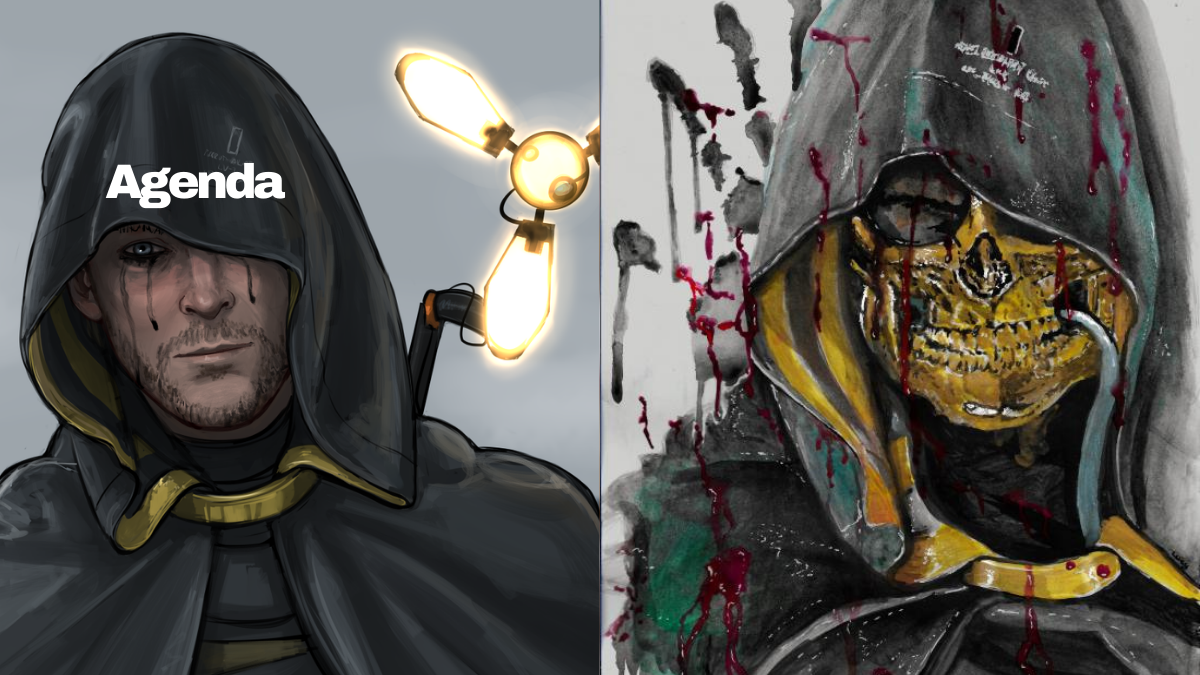
The golden skull mask worn by Higgs is a defining visual component of his design, symbolizing decay wrapped in theatrics. Gold, historically associated with value, purity, and power, becomes perverse when molded into the form of a skull. The mask signifies not only Higgs’ desire to be seen as a figure of consequence but also his attempt to hide his fear of invisibility. Behind its shining surface, we see a man who can’t bear a world that refuses to acknowledge him. This is a motif woven throughout the Higgs Death Stranding analysis in community discussions and academic examinations alike.
The mask also acts as a literal and metaphorical medium of transformation. By donning it, Higgs adopts an identity elevated beyond his human limitations. The mask gives him permission to embrace darker impulses and perform the role of harbinger. It is a costume both empowering and imprisoning. In its theatricality, the mask hints at Higgs’ craving for recognition, while its macabre imagery exposes his proximity to death, destruction, and internal decay.
Higgs and Extinction Entity Mythology
The mythology surrounding the Extinction Entities (EEs) anchors the metaphysical architecture of Death Stranding’s world. Higgs’ connection to Amelie, as well as his co-option of EE power, reveals a yearning to belong to something cosmic. Unlike Sam, who reluctantly accepts his responsibilities, Higgs actively seeks to merge with extinction forces. This pursuit frames him as a vector for existential themes, turning the concept of an apocalypse into something intimate and psychologically driven.
Higgs’ enchantment with extinction reflects a personal nihilism wrapped in quasi-religious awe. He sees himself as an apostle of oblivion, interpreting the Death Stranding not as a catastrophe but as a destiny. In this sense, the Higgs Death Stranding interpretation extends into philosophical territory. He wants to be chosen—by Amelie, by fate, by the universe. By embracing extinction, Higgs believes he has found a role worthy of his ambitions, even if that role is annihilation.
Psychological Profile of Higgs as an Antagonist
Psychologically, Higgs displays traits commonly associated with inferiority complexes merged with grandiose delusions. He holds deep insecurity masked by violence and spectacle. This dynamic is familiar in real-world personality disorders, and Kojima’s creative direction seems intentionally designed to evoke such parallels. Higgs wants control, but what he truly craves is validation. When control slips, his desperation intensifies, revealing emotional volatility beneath the confidence he projects.
His antagonism toward Sam further highlights this instability. Higgs envies Sam’s quiet heroism and the genuine connections Sam forms. He perceives connection as weakness but simultaneously longs for it. This is the tension at the heart of his psychological makeup. Many Higgs Death Stranding analyses point to this as his central contradiction: he hates the world for not embracing him while despising himself for needing that embrace.
Higgs’ Relationship With Amelie
Higgs’ relationship with Amelie is layered, complex, and rich with ambiguity. He admires her, fears her, and depends on her, creating a triad of emotional conflict. His reverence for her as an Extinction Entity borders on devotion. Yet this devotion is tainted with resentment, as he struggles against the idea that his power is borrowed rather than intrinsic. In this sense, Amelie represents both empowerment and emasculation for Higgs.
Higgs’ emotional tether to Amelie underscores the fragility of his ego. He oscillates between seeking her approval and asserting dominance, revealing an unstable dynamic. Narratively, their relationship underscores the political and metaphysical tensions driving the world’s collapse. Their alliance shapes the trajectory of the Higgs Death Stranding storyline, making it one of the most critical relationships in the game’s lore.
Higgs and Sam Porter Bridges: A Study in Duality
The contrast between Higgs and Sam is deliberate and thematically significant. Sam represents connection, healing, and reluctant heroism. Higgs embodies disconnection, destruction, and performative villainy. This duality is a classic narrative device but executed with exceptional nuance in Death Stranding. Their encounters are not merely conflicts but philosophical debates made physical. Where Sam builds, Higgs breaks. Where Sam bonds, Higgs isolates higgs death stranding.
Their rivalry is also personal. Higgs resents Sam not because he hates him, but because Sam exposes the emptiness of Higgs’ worldview. Sam’s quiet perseverance undermines Higgs’ belief that the world is meaningless. This ideological dissonance fuels the emotional energy of their interactions. In many Higgs Death Stranding analyses, their relationship is described as a clash between two worldviews rather than two individuals.
The Role of Humor and Theatrics in Higgs’ Persona
Higgs’ theatrical nature differentiates him from most antagonists in the genre. His sarcastic humor, flamboyant posture, and confident swagger add a peculiar charm to his otherwise brutal methods. Humor becomes a coping mechanism, a shield against insecurity, and a tool of intimidation. This blend of levity and terror helps establish his identity as someone who refuses to be forgotten, even in the face of apocalypse.
His theatrics also serve a narrative function. They remind the player that Higgs is performing—not only for Sam but for himself. The closer one looks at his bravado, the more transparent the cracks become. This performative nature is central to evaluating the Higgs Death Stranding narrative layer, signaling that the mask isn’t just literal but psychological. He acts larger than life because he fears being ordinary.
Higgs and the Theme of Isolation
Isolation is a core theme in Death Stranding, and Higgs personifies it in a distorted way. Unlike Sam, who experiences isolation but strives for connection, Higgs embraces loneliness as both a defense and a statement. He believes the world deserves to be isolated, fragmented, and silent. His ideology mirrors real-world social fissures found in politics, digital culture, and personal psychology.
Yet paradoxically, Higgs’ isolation is self-inflicted. His worldview alienates him, pushing others away. This reinforces his negative beliefs and strengthens his commitment to the destructive path. Many scholars of the Higgs Death Stranding narrative point out this self-perpetuating cycle as one of the most tragic elements of his character. Higgs becomes proof that isolation, once embraced, can transform into ideology.
Higgs’ Combat Style and Supernatural Abilities
Mechanically, Higgs’ abilities are among the most distinctive in the game, blending supernatural manipulation with strategic confrontations. His capacity to summon BTs, create battlefield distortions, and engage in psychological warfare sets him apart as an unpredictable antagonist. These powers are a manifestation of his role as a harbinger of extinction and demonstrate his willingness to bend the rules of reality for his ends higgs death stranding.
The presentation of his combat encounters reinforces his persona. Higgs relishes the spectacle of conflict. He choreographs his battles as performances, taunting Sam and framing each encounter like a twisted show. This reflects his love of theatrics and obsession with attention. Through gameplay, the Higgs Death Stranding experience exposes his desire to be seen—not just to win.
Higgs as a Commentary on Despair Culture
Higgs can be read as a metaphor for despair culture in modern society. His outlook mirrors the belief that collapse is inevitable and resistance is futile. Many individuals in today’s world experience similar nihilistic fatigue, feeling overwhelmed by climate anxiety, political instability, economic uncertainty, or social fragmentation. Higgs transforms this despair into doctrine, advocating for surrender rather than resilience higgs death stranding.
By embodying this worldview, Higgs becomes a cautionary figure. His path illustrates how despair, if left unchecked, can evolve into destructive behavior and ideological extremism. The Higgs Death Stranding narrative suggests that despair is not merely a personal emotion but a societal threat when weaponized. Through Higgs, the game critiques surrender to hopelessness and elevates connection as a counterforce.
Higgs and the Aesthetics of Apocalypse
Visually, Higgs contributes to Death Stranding’s signature apocalyptic aesthetics. His gold-accented attire, skeletal motifs, and theatrical expressions evoke imagery of both ritual and decay. These aesthetic choices signal an identity intertwined with endings. Higgs wants to be the face of destruction, and his appearance reinforces this personal branding.
The aesthetics extend beyond costume design; they inform the tone of every scene he appears in. Environments warp around his presence, BTs respond to his call, and the weather intensifies his aura. He is a walking omen. Many players describe their encounters with the Higgs Death Stranding sequences as visually striking moments that blend beauty with dread, highlighting the game’s unique artistic direction.
Moral Ambiguity and Motivations
While Higgs performs the role of villain, his motivations are not entirely without sympathy. He is a man shaped by trauma, abandonment, and disillusionment. His belief in extinction is grounded in the perception that the world is irreparably broken. This is a perspective not unfamiliar in real-world social commentary, where systemic issues often lead individuals to bleak conclusions.
What makes Higgs morally complex is that his underlying desires—to matter, to be understood, to be seen—are deeply human. The tragedy lies in how he chooses to pursue those desires. Many Higgs Death Stranding discussions hinge on this ambiguity, debating whether he is a monster by choice or circumstance. The game intentionally leaves this open, encouraging reflection rather than judgment.
The Evolution of Higgs’ Character Ar
Higgs’ arc is not static. He evolves from a mysterious antagonist into a figure whose vulnerabilities and contradictions become increasingly exposed. Early appearances portray him as omnipotent and theatrical. As the story progresses, cracks appear. His reliance on Amelie becomes evident. His fear of irrelevance intensifies. His motivations become more desperate.
This evolution culminates in the climactic confrontations where Higgs’ bravado fades, revealing a man cornered by his own philosophy. His final moments illustrate the tragic dimension of his character. Many scholars argue that the Higgs Death Stranding arc serves as a commentary on self-destructive ideologies and the psychological toll of living without hope or connection.
Comparative Analysis Table: Higgs vs. Sam Porter Bridges
| Element | Higgs | Sam Porter Bridges |
| Core Philosophy | Embrace extinction | Preserve connection |
| Emotional State | Nihilistic despair | Wounded resilience |
| Motivation | Validation through destruction | Healing through service |
| Relationship to Amelie | Devotional dependence | Personal conflict and duty |
| Symbolism | Death, endings, spectacle | Life, connection, endurance |
| Combat Style | Supernatural theatrics | Practical physicality |
| Narrative Function | Antagonist and mirror | Protagonist and anchor |
| Psychological Core | Inferiority masked by grandeur | Trauma transformed into purpose |
Higgs’ Influence on Worldbuilding
Higgs is not merely a character but a worldbuilding device. His actions influence geopolitical tensions, social fragmentation, and supernatural events across the game’s landscape. His manipulation of BTs and his ideological pressure contribute to destabilizing fragile settlements. Through Higgs, the player witnesses how a single individual can shape the world through both beliefs and actions.
His presence also gives context to elements like DOOMS abilities, the rise of Homo Demens, and the dynamics of the chiral network. Without Higgs, many of these elements would lack connective tissue. The Higgs Death Stranding lore threads reinforce that antagonists can be as crucial to worldbuilding as heroes, shaping the ecosystem of the story.
Higgs and Real-World Parallels
Higgs’ character reflects several real-world archetypes, including the disillusioned extremist, the self-styled prophet, and the emotionally wounded performer. His attraction to chaos echoes individuals who embrace radical ideologies to find purpose. His performative style resembles media-driven figures who thrive on spectacle. His fragility reflects those shaped by unresolved trauma.
These parallels allow players to interpret Higgs through sociopolitical and psychological lenses. He stands as a symbolic commentary on modern disconnection, fear, and the search for identity within collapsing systems. This makes the Higgs Death Stranding narrative one of the most thematically resonant aspects of the game, extending its relevance well beyond its fictional setting.
Notable Quotes and Dialogue
One of the most memorable traits of Higgs is his eloquent, theatrical manner of speaking. His lines balance arrogance, charisma, and fatalism. Perhaps the most representative quote of his worldview is this:
“It’s time for you to do the work—so we can both find out what we’re made of.”
This line encapsulates his competitive nature, his hunger for validation, and his belief that conflict is the only authentic way to reveal truth. Many Higgs Death Stranding analyses highlight this quote as emblematic of his philosophical posture.
Higgs’ Legacy in the Death Stranding Universe
Even after the main storyline’s completion, Higgs’ influence persists. Players continue to theorize about his potential future roles, his deeper connections to the universe’s metaphysics, and his unresolved psychological threads. His presence in supplemental materials, community discussions, and speculative lore analysis demonstrates his enduring relevance.
Higgs’ legacy also shapes interpretations of the themes that define the franchise: connection, extinction, identity, and purpose. He stands as both warning and symbol. The Higgs Death Stranding narrative continues to inspire thought, debate, and reinterpretation years after the game’s release.
The Cultural Impact of Higgs
Culturally, Higgs has become a standout figure in modern gaming. His visual design, voice performance, and narrative significance have cemented him as one of Kojima’s most iconic antagonists. Streamers, critics, and narrative theorists frequently highlight him as a key reason the game’s story resonates on an emotional and intellectual level.
His role extends beyond the game itself into discussions of storytelling innovation, character design, and thematic complexity. The Higgs Death Stranding phenomenon reflects how a well-crafted antagonist can become a cultural touchpoint, shaping the legacy of a franchise. Higgs’ blend of charm, terror, and philosophical depth ensures that he remains prominent in both fan culture and academic critique.
The Future of Higgs in Potential Sequels
With the announcement and anticipation surrounding future entries in the series, speculation about Higgs’ potential return runs high. Kojima Productions is known for complex, layered storytelling where characters rarely vanish completely. While Higgs’ fate appears sealed, the metaphysics of the Death Stranding universe leaves room for reinterpretation, echo, or even resurrection through narrative mechanisms like chiral echoes or alternate timelines.
Fans argue that his unfinished emotional threads and symbolic resonance could justify his reemergence in a new form. Whether as antagonist, phantom presence, or thematic callback, the Higgs Death Stranding narrative arc may not be complete. His return would offer opportunities to deepen the exploration of the universe’s existential themes.
Final Reflections on Higgs as a Narrative Force
Higgs embodies narrative tension, ideological conflict, and emotional fragility. He stands at the intersection of chaos and meaning. By examining him closely, we unlock deeper understanding of the game’s themes and appreciate the artistry behind Kojima’s storytelling. Higgs challenges players to confront despair, question ideology, and reflect on the power of connection.
His character leaves a lasting mark not because he is unstoppable, but because he is painfully human beneath the spectacle. The Higgs Death Stranding analysis reveals a figure who mirrors society’s anxieties and aspirations. As long as narratives grapple with existential questions, characters like Higgs will remain indispensable.
Conclusion
Higgs remains one of the most complex antagonists crafted in contemporary gaming. His blend of nihilism, longing, theatricality, and destructive ambition shapes not only the story of Death Stranding but also its thematic backbone. Through his mask, abilities, relationships, and symbolism, Higgs becomes more than a villain—he becomes a lens through which players explore connection, despair, and identity.
The significance of Higgs death stranding extends far beyond the screen. He stands as a character rich with narrative potential, psychological depth, and cultural impact. Understanding Higgs is essential to understanding the emotional and philosophical architecture of the entire Death Stranding universe.
Frequently Asked Questions
What makes Higgs in Death Stranding such a compelling antagonist?
Higgs is compelling because his nihilism, theatrics, and personal vulnerabilities form a multilayered portrayal. His role in the Higgs Death Stranding story blends spectacle with emotional realism, making him memorable and complex.
Why does Higgs wear a golden skull mask?
The mask symbolizes both power and fragility. In the Higgs Death Stranding narrative, it acts as protection, performance, and a statement about his obsession with extinction and identity.
How does Higgs compare to Sam Porter Bridges?
Sam embodies connection, while Higgs represents isolation and destruction. Their dynamic fuels the emotional intensity of the Higgs Death Stranding storyline.
Is Higgs truly evil, or is he misunderstood?
He is morally ambiguous. While he performs villainous acts, the Higgs Death Stranding arc shows his choices are driven by trauma, insecurity, and existential despair.
Will Higgs return in future Death Stranding titles?
While uncertain, the metaphysical nature of the universe leaves possibilities open. Many fans believe the Higgs Death Stranding themes could support his return in symbolic or narrative form